Joint Vive Review (2026): Do the Drops Deliver Enough?
Disclosure: This article contains affiliate links. If you purchase through them, we may earn a commission at no extra cost to you. Our editorial assessments are not influenced by these relationships — we cover both strengths and limitations of every product we review.
Joint Vive Review (2026): Do the Drops Deliver Enough?
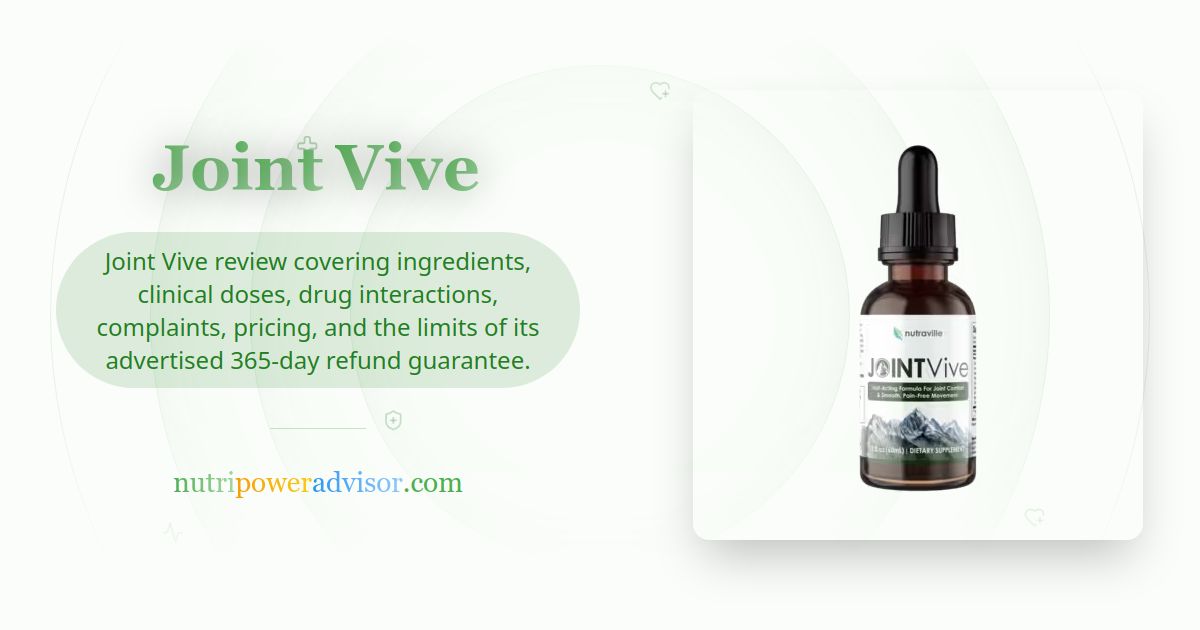
Quick Verdict
Here is the straightforward bottom line: Joint Vive has a plausible ingredient story, but buyers lack the information needed to judge its actual potency. I did not find a published clinical trial of the finished formula during this review. Research on individual ingredients cannot establish that this particular combination works.
Some ingredients deserve consideration. Specific pine bark extracts have been studied for knee osteoarthritis, and a tamarind-containing combination has produced encouraging short-term results. However, the research used identifiable preparations and measured doses. Those details matter as much as the ingredient names.
My biggest concerns are dose transparency, conflicting published directions, and medication compatibility. Ginkgo and chlorella create different concerns for warfarin users. Other ingredients warrant additional checks with aspirin, diabetes treatment, and certain prescription medicines. An unverified dose makes those questions harder to resolve.
The purchase terms offer some reassurance, but a refund cannot establish effectiveness or prevent an interaction. This is a review of public product information and published research, not a report of personal use or laboratory testing. I would resolve the formulation questions before ordering.
Rating: 3.1 / 5
This is an editorial assessment of evidence, transparency, practical usefulness, and purchase protection. It is not a measured treatment effect or a simple average of the stars.
| Factor | Star assessment | Reason |
|---|---|---|
| Ingredient research | ⭐⭐⭐ | Some relevant human evidence, with substantial limitations |
| Finished-formula evidence | ⭐ | No published Joint Vive clinical trial located |
| Dose transparency | ⭐ | Ingredient amounts and extract equivalence could not be verified |
| Convenience | ⭐⭐⭐⭐ | A liquid can appeal to adults who dislike capsules |
| Medication compatibility | ⭐⭐ | Several ingredients require a pharmacist's review |
| Marketing credibility | ⭐⭐ | Fluoride framing, conflicting directions, and unverified media associations |
| Value for money | ⭐⭐⭐ | Depends on the actual dose and checkout price |
| Advertised refund protection | ⭐⭐⭐⭐ | Long window, with practical conditions needing clarification |
→ Check the current Joint Vive offer with its advertised 365-day guarantee
Table of Contents
- What Is Joint Vive?
- The Single-Drop Dose Problem and the Fluoride Story
- Joint Vive Ingredients Analysis
- Why the Liquid Format Matters
- Realistic Results Timeline
- Real Customer Feedback
- When to See a Doctor Instead
- Critical Safety Information and Drug Interactions
- Who Joint Vive Is Genuinely Right For
- Who Should Skip This Product
- Pricing and the 365-Day Guarantee
- Joint Vive vs. Joint Genesis
- The Honest Verdict
- Frequently Asked Questions
What Is Joint Vive?
Joint Vive, also styled JointVive, is an oral liquid supplement positioned for joint comfort, flexibility, and mobility. Its official website lists pine bark extract, tamarind, chlorella, ginkgo biloba, spirulina, lion's mane mushroom, bacopa monnieri, moringa, and neem.
Nutraville is associated with the product through a company-attributed release and its own storefront. I could not independently verify the contract manufacturer, production facility, or batch-specific test results. A commercial description of manufacturing standards is not an independent audit.
The website identifies ClickBank as retailer. The shipping page names an Ohio fulfillment location. Neither a retailer nor a fulfillment company should be confused with the factory making the formula.
The important missing information is the daily amount of each ingredient, its standardized composition, and an unambiguous serving volume. Without those details, buyers cannot make a meaningful comparison with clinical research.
The Single-Drop Dose Problem and the Fluoride Story
The serving instructions conflict
The homepage recommends one drop daily. A Nutraville-attributed release instead describes one full dropper twice daily. Those are substantially different instructions. The homepage directions and release do not establish which applies to the bottle currently being sold.
Different versions or outdated copy might explain the discrepancy. It does not prove deception. It does mean consumers should obtain written clarification and the current label before use.
Do not convert a drop into a dropperful yourself. Increasing an unknown blend could also increase its interaction risk.
What a literal drop could hold
Consider a hypothetical drop measuring 0.05 mL, with a liquid density of 1 g/mL:
0.05 mL × 1 g/mL = 0.05 g, or 50 mg of total liquid.
That includes the solvent and every ingredient. Under those assumptions, the drop cannot contain 100 mg of pine bark extract alone, the daily amount used in one relevant trial.
Delivering 100 mg in that volume would require:
100 mg ÷ 0.05 mL = 2,000 mg/mL.
A 250 mg research preparation would require 5,000 mg/mL.
These are illustrations, not measurements of Joint Vive. Its actual drop size, density, concentration, and serving remain unverified. A different extract might require a different amount, but that requires evidence of equivalence. An extraction ratio cannot automatically substitute for a clinical dose.
The conclusion is narrow: a literal small drop of an ordinary liquid cannot reproduce those studied extract masses. Whether this product supplies a meaningful alternative dose cannot be determined from the information reviewed.
Fluoride research does not establish a joint treatment
The company-attributed release discusses fluoride research as part of its formulation rationale, while acknowledging that high-exposure findings do not explain typical joint concerns.
There is real research behind part of that story. Khandare et al. 2002, in the European Journal of Clinical Nutrition, studied 20 boys, with 18 completing the trial. Eating 10 g of tamarind daily for 18 days increased urinary fluoride excretion from 3.5 to 4.8 mg/day compared with the control diet. The study did not test Joint Vive, ordinary adult osteoarthritis, or pain relief. Read the trial.
Skeletal fluorosis from excessive exposure is a recognized condition. However, the NIH fluoride fact sheet states that it is extremely rare in the United States and that evidence does not indicate recommended public-water fluoride levels cause it.
A urinary excretion finding does not demonstrate that supplement drops remove the cause of everyday knee stiffness. Describing that extrapolation as established treatment would be misleading. Suspected excessive exposure calls for medical assessment and investigation of the source.
Media logos and other marketing claims
A related Nutraville listing titled JointVive X x 3 displays CBS, ABC, NBC, and Fox logos under an “As seen on” heading. I could not verify corresponding product coverage or endorsements. The listing's additional “X” designation also means its formula should not automatically be assumed identical.
Media logos do not establish clinical approval. Nor does publication on a press-release service amount to independent medical reporting.
I did not verify celebrity endorsements, a doctor using a pen name, or testimonials instructing customers to discontinue medicine on the target pages inspected. I also did not complete the purchase funnel, so I cannot establish whether post-purchase upsells occur.
Joint Vive Ingredients Analysis
For every ingredient below, the product's individual daily dose remains unverified. Research amounts are comparisons, not directions for self-dosing.
I reserve an ingredient ⭐ for convincing evidence relevant to the proposed use. None earns that designation for established joint benefits at this product's unknown dose.
Pine bark extract: promising studies, very low certainty overall
Belcaro et al. 2008, in Phytotherapy Research, randomized 156 adults with knee osteoarthritis to Pycnogenol, a specific French maritime pine bark extract, or placebo. Participants took 100 mg daily for three months. The abstract reported global WOMAC symptom-score reductions of 56% versus 9.6%. These were changes from baseline within each group, not a guarantee of 56% pain relief. Read the trial.
The broader assessment is more cautious. Robertson et al. 2020, in the Cochrane Database of Systematic Reviews, included three osteoarthritis trials involving 293 participants and rated the evidence very low certainty. Small samples and reporting limitations prevented firm conclusions about effectiveness or safety. Read Cochrane's review.
Procyanidins provide a plausible antioxidant and inflammatory-signaling mechanism. Still, generic pine bark is not automatically equivalent to Pycnogenol. Assessment: one of the more relevant ingredients, but research identity, standardization, and dose must match before results can be transferred.
Tamarind: the best joint trial tested a combination
Kare et al. 2022, in Evidence-Based Complementary and Alternative Medicine, randomized 90 adults with knee osteoarthritis; 81 completed 56 days. One group received 250 mg/day of TamaFlex, combining tamarind seed and turmeric extracts. Another received a different combination, and the third received placebo. Read the study.
In the TamaFlex group, WOMAC pain scores on a 0–100 scale fell from 50.40 to 24.66, versus 50.37 to 41.48 with placebo. That creates a calculated day-56 difference of 16.82 points. It is an encouraging result, but it does not isolate tamarind's contribution or validate an unspecified tamarind preparation.
Proposed mechanisms involve inflammatory pathways and protection against cartilage breakdown in experimental models. The trial did not establish structural cartilage rebuilding. Assessment: relevant combination evidence, with a major formulation mismatch.
Chlorella: experimental joint research is not oral supplement evidence
Chang et al. 2026, in Exploration, investigated chlorella and engineered chlorella biohybrids in cartilage-cell experiments and mouse osteoarthritis models. The work explored mitochondrial function and cellular energy metabolism; parts involved an engineered material and near-infrared stimulation. Read the primary research.
That is an experimental treatment approach, not evidence that swallowing chlorella drops improves human arthritis. It supplies neither a validated oral joint dose nor a human pain-relief estimate.
Assessment: interesting preclinical research, insufficient support for the proposed consumer use. Its potential vitamin K interaction with warfarin is more immediately relevant to buyers.
Ginkgo biloba: a small adjunctive trial exists
Al-Haddad et al. 2022, revised in 2023 in F1000Research, reported an eight-week study with 60 completers. Ginkgo extract at 120 mg twice daily was added to standard diclofenac and paracetamol treatment, compared with the same medicines plus placebo. Pain and several functional scores improved more with ginkgo, while quality-of-life scores did not significantly differ. Read the trial.
This provides preliminary human evidence, but it does not show that ginkgo works alone. Proposed explanations include effects on inflammatory signaling and circulation. The study's size and adjunctive design limit confidence, and its 240 mg daily extract dose cannot be matched to the product.
Assessment: preliminary support, accompanied by meaningful medication precautions. This trial is not permission to combine ginkgo with pain medicines without professional advice.
Spirulina: biological activity without established arthritis relief
Spirulina contains phycocyanin and other compounds investigated for antioxidant and immune effects. However, Ansarin et al. 2025, in Molecular Biology Reports, reviewed rheumatoid-arthritis research and found 13 eligible animal studies, with no eligible human studies. Rheumatoid arthritis also differs from osteoarthritis. Read the review.
Human research in other settings does not close that gap. Park et al. 2008, in Annals of Nutrition and Metabolism, studied 78 older adults taking 8 g/day for 16 weeks, examining lipid and immune markers rather than arthritis pain. University publication record.
Assessment: biological activity is plausible, but there is no established joint-relief dose to compare with this blend.
Lion's mane mushroom: animal findings need human confirmation
Yang et al. 2022, in Nutrients, studied lion's mane mycelium in rats with surgically induced osteoarthritis. The work reported changes in joint pathology and inflammatory measures. It did not test adults taking a commercial liquid. Read the study.
Human lion's mane studies in other health areas cannot be repurposed as proof of joint lubrication or cartilage repair. Mushroom material, extraction method, and active-compound content also affect comparability.
Assessment: preclinical support only for this use. A human joint-pain effect size and corresponding oral dose cannot be supplied from this research.
Bacopa monnieri: cognitive research does not validate joint claims
Bacopa's better-known human research concerns cognition. Calabrese et al. 2008, in the Journal of Alternative and Complementary Medicine, randomized 54 older adults and tested a standardized extract at 300 mg/day for 12 weeks. The outcomes concerned cognition, anxiety, and depression, not joint pain. Read the trial.
Laboratory findings involving antioxidant or inflammatory pathways are reasons for further investigation. They do not establish meaningful arthritis relief. I did not identify convincing standalone human knee-osteoarthritis evidence for bacopa during this review.
Assessment: no established joint dose or joint-specific benefit demonstrated here. Its cholinergic effects also warrant attention with certain medicines.
Moringa: limited human evidence includes a negative comparison
Valerio et al. 2014, in Health Sciences Journal, reported a small, nonrandomized, placebo-controlled study involving 16 people with osteoarthritis or rheumatoid arthritis. Participants used moringa capsules alongside their usual medicines for one week. There was no significant between-group difference in pain relief. Read the institutional study record.
Moringa contains polyphenols and other compounds with anti-inflammatory activity in experimental systems. That mechanism does not overcome the limited clinical evidence. Studies of root poultices would also be poor matches for an oral liquid.
Assessment: insufficient evidence to recommend it for joint pain. A validated oral joint dose cannot be established from this small study.
Neem: glucose findings matter more than joint claims
Neem preparations vary substantially by plant part and extraction method. I did not identify a human knee-osteoarthritis trial establishing a useful dose for this product's purpose.
Pingali et al. 2020, in Diabetes, Metabolic Syndrome and Obesity, randomized 80 adults already taking metformin. A standardized aqueous leaf-and-twig extract at 125, 250, or 500 mg twice daily for 12 weeks improved glucose measures compared with placebo. This was diabetes research, not an arthritis trial. Read the study.
Assessment: an unproven joint ingredient with potential relevance to glucose monitoring. The trial does not establish that this blend causes hypoglycemia, but it argues against treating neem as pharmacologically inactive.
Why the Liquid Format Matters
A liquid may be convenient for someone who dislikes swallowing capsules. That practical advantage deserves recognition. It does not establish faster pain relief or superior absorption.
If a supplement is swallowed, its ingredients generally still encounter the digestive system. Claims of meaningful absorption under the tongue require evidence for the particular compounds and formulation. A dropper bottle alone does not demonstrate that the digestive tract is bypassed.
Three details would make the format assessable: the serving volume in milliliters, the amount of each active ingredient in that volume, and the extract specifications. Without them, “concentrated” describes a presentation rather than a verified clinical advantage.
A liquid can contain useful doses when appropriately formulated. The difficulty here is the unresolved relationship between volume, concentration, and published directions.
Before choosing it for convenience, request a readable current label and written serving instructions. If those remain unavailable, a fully disclosed alternative is easier to evaluate.
→ See current Joint Vive pricing and packages
Realistic Results Timeline
There is no validated Joint Vive response timeline. The schedule below is a framework for monitoring an optional, clinician-approved trial, not a forecast.
| Period | Reasonable expectation | Useful action |
|---|---|---|
| Before starting | No benefit can be predicted | Confirm diagnosis, formula, serving, and medication compatibility |
| Week 1 | Tolerability may become apparent | Record digestive symptoms, rash, dizziness, or unusual bruising |
| Week 2 | Symptom fluctuations remain difficult to interpret | Compare the same daily activities under similar conditions |
| Weeks 3–4 | Subjective changes may occur, but are not assured | Track pain and function rather than vague impressions |
| Weeks 5–8 | Some ingredient studies assessed outcomes in this period | Review whether any improvement is consistent and useful |
| Weeks 9–12 | This overlaps the duration of pine bark trials | Reassess benefit, adverse effects, and cost with your clinician |
| Beyond 12 weeks | Longer use does not guarantee eventual success | Avoid continuing indefinitely without a clear reason |
The honest truth: research durations for other preparations cannot predict whether these drops will help.
Choose practical measures, such as discomfort during the same walk, morning stiffness duration, or difficulty using stairs. Keep prescribed treatment consistent unless your clinician changes it. Otherwise, attributing an improvement to the supplement becomes especially difficult.
Real Customer Feedback
I could not verify a sufficiently reliable body of independent, purchase-confirmed Joint Vive reviews to calculate a satisfaction rate or establish recurring complaint patterns.
The vendor's testimonial disclaimer acknowledges that testimonials are selected, may be shortened, and do not represent every customer's experience. That limits their usefulness for predicting typical outcomes.
| Feedback area | What can responsibly be concluded |
|---|---|
| Positive accounts | Individual reports may describe improvement, but do not establish causation or average benefit |
| Negative experiences | I could not confirm enough attributable reports to identify dependable product-specific patterns |
| Side effects | Available feedback cannot establish their frequency |
| Refund performance | Published promises do not establish how consistently requests are fulfilled |
| Review quality | Promotional articles and anonymous posts should not be treated as verified customer surveys |
I also could not substantiate a Joint Vive-specific Trustpilot pattern of pricing disputes. The pricing discrepancies discussed below come directly from seller pages, rather than an inferred complaint trend.
The lack of dependable feedback should lower confidence. It should not be filled with invented customer names, reconstructed quotations, or a claimed success percentage.
A useful review identifies the purchased formula, serving, duration, other treatments, and a concrete outcome. A dramatic testimonial without those details carries little evidential weight.
When to See a Doctor Instead
Joint pain has multiple possible causes. A supplement is a poor way to determine which one applies.
Seek urgent assessment for a hot, swollen joint, particularly with fever, chills, or feeling unwell. An infected joint needs prompt treatment. Get emergency care after an injury if the joint is deformed, you cannot bear weight, or you develop numbness or loss of sensation. These warnings follow NHS joint-pain guidance.
Arrange a medical appointment if pain affects sleep or normal activities, keeps returning, worsens, or has not improved after two weeks of home care. Morning stiffness lasting more than 30 minutes also merits assessment.
For diagnosed osteoarthritis, tailored exercise is a core treatment. NICE recommends strengthening and aerobic activity suited to the person. Its guidance also supports topical NSAIDs for knee osteoarthritis when appropriate. Read NICE's exercise guidance and treatment rationale.
These options deserve attention before spending heavily on a formula whose dose cannot be checked.
Critical Safety Information and Drug Interactions
The following concerns relate to ingredients. They do not demonstrate that a particular interaction has occurred with Joint Vive. Unknown amounts prevent a reliable estimate of the blend's risk.
Warfarin: two ingredients create different concerns
Ginkgo may increase bleeding risk with warfarin. Stoddard et al. 2015, in AMIA Annual Symposium Proceedings, reported an observational association with bleeding: hazard ratio 1.38, with a 95% confidence interval of 1.20–1.58. Observational evidence can identify a signal but cannot prove causation. Read the study.
The human evidence is mixed. Small controlled studies have not consistently demonstrated an interaction, but NCCIH still advises caution. That is a clinically relevant precaution, not a prediction that everyone will bleed.
Chlorella presents a different issue: vitamin K can reduce warfarin's anticoagulant effect. Ohkawa et al. 1995, in Rinsho Shinkeigaku, described reduced anticoagulation associated with chlorella in a case report. Read the report.
These effects do not safely cancel each other. A mixture could make anticoagulation management less predictable. Warfarin users should avoid starting this blend without their anticoagulation clinician's approval. Tell the clinic about starting, stopping, or changing supplements; do not adjust warfarin yourself.
Other combinations that need review
| Medicine or treatment | Ingredient concern | Evidence and practical implication |
|---|---|---|
| Apixaban, rivaroxaban, dabigatran, clopidogrel, aspirin | Ginkgo and potentially pine bark | Possible additive bleeding effects; do not assume an untested combination is safe |
| Ibuprofen, naproxen, other NSAIDs | Ginkgo; tamarind may also matter with aspirin | A pharmacist should review regular use and the complete formula |
| Insulin, glipizide, gliclazide, other glucose-lowering medicines | Neem and some pine bark preparations | Additional glucose effects are plausible; monitoring may need adjustment |
| Cevimeline and other cholinergic medicines | Bacopa | A suspected human interaction exists; other combinations require individual assessment |
| Levothyroxine or treatment for thyroid disease | Bacopa | Concern comes mainly from animal findings, not a demonstrated human interaction |
| Tacrolimus, ciclosporin, or other immunosuppressive treatment | Spirulina and chlorella | Potential immune effects create a theoretical concern; clinical drug failure is not established |
specifically warns about potential bleeding effects with anticoagulants and antiplatelet medicines.
Tamarind deserves a separate qualification. Mustapha et al. 1996, in the European Journal of Drug Metabolism and Pharmacokinetics, studied six healthy volunteers. Tamarind fruit extract in a meal increased aspirin exposure after a 600 mg aspirin dose. It did not measure bleeding outcomes, and its applicability to an unidentified extract is unknown. Read the study.
Bacopa: distinguish a case report from animal speculation
Acquarulo et al. 2022, in the Journal of Medical Case Reports, described suspected cholinergic toxicity in someone taking cevimeline after adding a supplement containing bacopa and phosphatidylserine. Symptoms included sweating, nausea, and tachycardia. This was one case involving a combination supplement, so bacopa's responsibility was not established. Read the case.
The thyroid concern is weaker. Kar et al. 2002, in the Journal of Ethnopharmacology, found thyroid-hormone changes in mice. That does not establish a human interaction with levothyroxine. Read the animal study.
Diabetes medicines and immunosuppressants
The neem trial discussed earlier demonstrates additional glucose effects for one standardized extract. It does not establish dangerous hypoglycemia from this product. Nevertheless, someone using insulin or a sulfonylurea should obtain advice before adding it.
For algae ingredients, immune-marker changes provide a reason for caution with immunosuppressants, rather than proof of treatment failure. Kwak et al. 2012, in Nutrition Journal, found changes in natural-killer-cell activity and cytokines with 5 g/day chlorella over eight weeks. Read the trial.
Lion's mane also has laboratory antiplatelet findings, but these do not establish an interaction in people swallowing supplements. Moringa's reported effects on drug-metabolizing enzymes are largely preclinical, with uncertain clinical relevance. Read the lion's mane experiment and MSK's moringa assessment.
Other safety considerations
Pregnant or breastfeeding people, children, and adults with significant liver or kidney disease should not self-start this poorly characterized combination. Inform surgical and dental teams about it before procedures; they should decide whether and when it needs stopping.
Ask for testing covering identity, potency, heavy metals, microbes, and relevant algal toxins. The FDA explains that blue-green algae products can be contaminated with microcystins. That is a category concern, not evidence this product is contaminated.
Seek urgent care for severe bleeding, black stools, vomiting blood, fainting, breathing difficulty, or facial swelling. Never discontinue prescribed arthritis treatment, anticoagulants, or diabetes medicines to accommodate a supplement.
Who Joint Vive Is Genuinely Right For
Its potential audience is narrow and conditional:
- ✅ Adults with an established explanation for mild joint discomfort who want an optional supplement alongside their care.
- ✅ People who prefer liquids and can obtain clear, current serving instructions.
- ✅ Buyers whose pharmacist has reviewed the actual label and medication list.
- ✅ Readers comfortable with preliminary evidence and the possibility of no benefit.
- ✅ People who can afford the purchase without displacing exercise, physiotherapy, or prescribed treatment.
- ✅ Buyers willing to request dose and testing information before committing.
Even for these readers, eligibility does not establish effectiveness. If the seller cannot answer the formulation questions, a different product is easier to justify.
Who Should Skip This Product
- ❌ Anyone with unexplained, severe, hot, or swollen joints.
- ❌ Warfarin users without specific approval from their anticoagulation clinician.
- ❌ People taking anticoagulants, antiplatelets, or regular NSAIDs without a medication review.
- ❌ People using insulin or sulfonylureas who cannot obtain advice about monitoring.
- ❌ Transplant recipients or people receiving immunosuppressive treatment without specialist clearance.
- ❌ Pregnant or breastfeeding people and children considering unsupervised use.
- ❌ Anyone expecting cartilage regeneration, a fluoride cleanse, or an arthritis cure.
- ❌ Buyers who require disclosed clinical doses or dependable independent customer evidence.
Pricing and the 365-Day Guarantee
The seller pages did not agree on the six-bottle offer when checked.
| Package | Homepage price per bottle | Homepage total | Alternate /ds/ total |
|---|---|---|---|
| One bottle | $69 | $69 | $69 |
| Three bottles | $59 | $177 | $177 |
| Six bottles | $29 | $174 | $294, or $49 per bottle |
Sources: Joint Vive homepage and alternate seller page.
On the homepage, six bottles cost $3 less than three. The alternate six-bottle total is $120 higher. This may reflect different promotions or outdated pages; I could not establish which price a particular checkout would honor.
Confirm quantity, final total, shipping, taxes, and payment terms before paying. A lower per-bottle price does not establish value when the active dose remains unknown.
Shipping wording also needs attention. The shipping policy says purchase prices include shipping, while other site wording distinguishes package and international charges. The final checkout should resolve the amount due.
What the guarantee establishes
The advertised window is 365 days. Nutraville's general refund policy promises a refund within 365 days of purchase and directs customers to support@nutraville.com. Joint Vive's product FAQ also refers to returning unused product.
Those statements leave practical questions: whether empty bottles qualify, whether return postage is reimbursed, and which conditions apply to purchases through different channels.
Before ordering, save the offer and request written answers. Keep bottles, receipts, and correspondence until the return requirements are clear. For a refund, contact the seller using the details on your receipt and request instructions before shipping anything.
Compared with [Joint Genesis's(/joint-genesis-review)] advertised 180-day empty-bottle promise, this offers more time but less explicit empty-bottle wording. Neither guarantee should be described as eliminating medical or financial risk.
Joint Vive vs. Joint Genesis
Joint Genesis is the relevant comparison from our review portfolio, where it received 4.0/5. That score is also an editorial assessment, not proof of a particular treatment response.
| Feature | Joint Vive | [Joint Genesis(/joint-genesis-review)] |
|---|---|---|
| Format | Liquid | Daily capsule |
| Formula approach | Nine botanical, algal, and mushroom ingredients | Mobilee-centered formula with supporting botanicals |
| Public dose assessment | Individual amounts could not be verified | Seller provides a linked Nutrition Label |
| Advertised guarantee | 365 days; return details need clarification | 180-day empty-bottle promise |
| Portfolio rating | 3.1/5 | 4.0/5 |
| Main buying consideration | Resolve serving and interaction questions first | Check the current label and medication compatibility |
The BioDynamix product page identifies Mobilee, pine bark, boswellia, ginger, and BioPerine, and publishes the label link and guarantee.
I would investigate that more assessable formula before buying undisclosed doses. However, this is not a declaration that Joint Genesis is suitable for every medication regimen. Its complete ingredients still need review.
Mobilee itself is a named hyaluronic-acid matrix with supplier specifications, which makes research matching more practical. A recognizable ingredient is an advantage in evaluation, not a substitute for clinical judgment. See the ingredient supplier's description.
For someone with diagnosed knee osteoarthritis, tailored exercise and appropriate medical treatment remain more important than choosing between supplements.
The Honest Verdict
Joint Vive receives 3.1/5. Some ingredient research warrants attention, but the formulation cannot be adequately assessed from the published information reviewed.
- ✅ Pine bark and a tamarind-containing combination have relevant human research.
- ✅ A liquid format may suit people who dislike capsules.
- ✅ The advertised refund window gives buyers substantial time.
- ⚠️ Ingredient studies use specific preparations that may differ materially from this product.
- ⚠️ Medication compatibility requires individual review.
- ❌ The serving instructions conflict across published materials.
- ❌ Individual doses and standardized composition could not be verified.
- ❌ Fluoride-excretion research does not establish ordinary joint-pain relief.
- ❌ I could not substantiate the displayed media associations or dependable customer success rates.
My recommendation is to obtain the current label and a pharmacist's assessment before considering an order. If the seller cannot provide clear answers, choose a more transparent option.
A better refund policy cannot compensate for an ingredient amount you cannot check.
→ See current Joint Vive pricing and packages
Frequently Asked Questions
1. Is Joint Vive a scam?
I found insufficient evidence to label it a scam. There is a commercial sales presence and published purchase information. However, that does not verify effectiveness, formula accuracy, or consistent refund fulfillment.
The appropriate conclusion is cautious: important transparency questions remain unresolved.
2. Does Joint Vive work for joint pain?
Its effectiveness as a finished product is unestablished in the published research I located. Some ingredients have preliminary evidence, but studies of specific extracts cannot validate an undisclosed mixture.
A response is possible, but a reliable probability or expected improvement cannot be calculated.
3. How long does Joint Vive take to work?
There is no clinically validated product-specific timeline. Relevant ingredient studies lasted approximately eight weeks to three months, using different preparations.
Those durations provide research context, not a promise that continued use will eventually produce results.
4. Is the correct serving one drop or one dropper?
The published directions conflict. Obtain the current bottle label and written confirmation from the seller. Do not assume a full dropper is equivalent to a drop or increase the amount to imitate research doses.
If the label and seller's response disagree, resolve that before using it.
5. Can I take Joint Vive with warfarin or another blood thinner?
Do not start it without professional review. Ginkgo presents a possible bleeding concern, while vitamin K in chlorella may reduce warfarin's effect.
Other anticoagulants and antiplatelet medicines also need checking. Unknown ingredient quantities prevent a dependable risk estimate.
6. What about aspirin, ibuprofen, or diabetes medicines?
These combinations warrant a pharmacist's assessment. Ginkgo may add to bleeding concerns, and a small human study found tamarind fruit extract increased aspirin exposure.
Some neem and pine bark preparations affect glucose. That supports monitoring precautions, especially with insulin or sulfonylureas, rather than assuming dangerous hypoglycemia has been established.
7. Is Joint Vive FDA approved?
Dietary supplements are not FDA approved for safety and effectiveness before sale. Manufacturing registration, inspection, or compliance claims do not establish that a formula treats arthritis.
The FDA explains this distinction. A logo or facility statement should not be interpreted as product approval.
8. How do I request a refund?
Start with the support information on your purchase receipt. Include your order number, purchase date, and refund request. Ask whether bottles must be returned and whether empty containers qualify.
The written policies do not settle every practical condition. Keep correspondence and use tracked shipping if a return is required.
9. Is Joint Genesis a better alternative?
It is easier to investigate because the seller links a Nutrition Label and identifies a named central ingredient. Our portfolio rates it higher.
That advantage concerns assessability and the previously reviewed evidence. It does not establish that it will outperform Joint Vive for every person or suit every prescription regimen.
10. Where should I buy Joint Vive?
Use a purchase route whose seller identity, exact formula, final price, and refund terms you can verify. A similar product name on another domain does not establish identical contents or protection.
If you decide to proceed after resolving the label and interaction questions, check the current Joint Vive offer and retain the complete order documentation.
→ Visit the official Joint Vive website
The supplement claims discussed here have not been evaluated by the U.S. Food and Drug Administration. Joint Vive is not intended to diagnose, treat, cure, or prevent disease. This review provides educational information and does not replace medical advice, diagnosis, or treatment. Consult a qualified healthcare professional before use, particularly if you take medicines or have a medical condition. Never change prescribed treatment because of supplement advertising or this article.
Tags: Joint Vive review, Joint Vive ingredients, does Joint Vive work, Joint Vive complaints, Joint Vive scam or legit, Joint Vive drug interactions, joint supplement drops, Joint Vive pricing, Joint Vive refund guarantee, supplements for joint stiffness