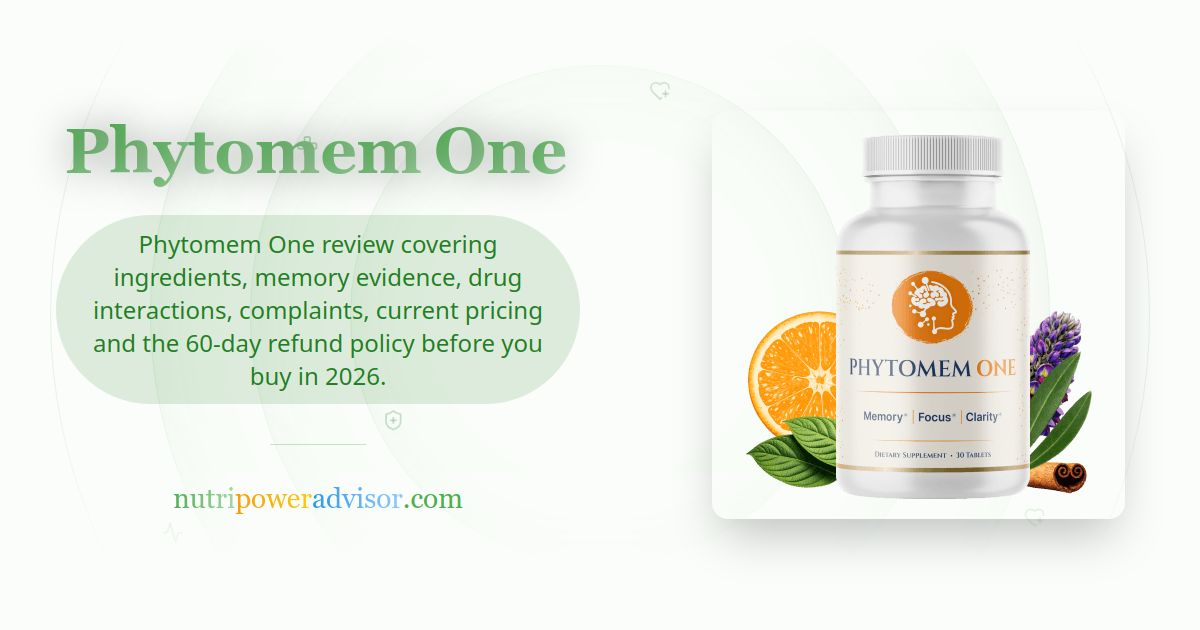
Phytomem One Review (2026): Can It Support Memory Safely?
Disclosure: This article contains affiliate links. If you purchase through them, we may earn a commission at no extra cost to you. Our editorial assessments are not influenced by these relationships — we cover both strengths and limitations of every product we review.
Phytomem One Review (2026): Can It Support Memory Safely?
Quick Verdict
Here is the straightforward bottom line: Phytomem One has some scientifically interesting ingredients, but I cannot recommend it confidently for improving memory. The missing information is consequential: independently verified ingredient amounts, evidence that the marketed preparations match research materials, and a published clinical trial of the complete formula.
Saffron provides the most relevant preliminary evidence. Some other ingredients have human research too, including small studies of fucoxanthin and olive leaf. Those findings are mixed, however, and studies measuring blood sugar or body weight cannot establish that this particular supplement improves recall.
Drug interactions deserve particular attention. Berberine has altered drug metabolism and increased cyclosporine exposure in human studies. Other possible concerns involve diabetes medicines, blood-pressure treatments and anticoagulants. Unknown ingredient quantities prevent estimating the interaction risk of the actual product.
My rating is 3.0 / 5. The formula is more credible than an entirely invented remedy, but its evidence and transparency do not justify the stronger promotional narratives associated with it. A refund policy offers financial protection under specified conditions; it does not establish effectiveness or medical safety.
Rating: 3.0 / 5
These factor ratings are editorial assessments, not a validated clinical scoring system.
| Factor | Rating | Assessment |
|---|---|---|
| Ingredient research | ⭐⭐⭐ 3/5 | Some relevant human studies, generally small or inconsistent |
| Finished-product evidence | ⭐⭐ 2/5 | No published randomized trial of Phytomem One verified |
| Dose transparency | ⭐⭐ 2/5 | Individual amounts could not be independently established |
| Medication suitability | ⭐⭐⭐ 3/5 | Important interaction concerns require individualized review |
| Marketing reliability | ⭐⭐⭐ 3/5 | Accessible presentations vary substantially in claim strength |
| Manufacturing transparency | ⭐⭐⭐ 3/5 | Manufacturer identity and batch testing remain insufficiently verified |
| Daily convenience | ⭐⭐⭐⭐ 4/5 | Simple daily format, although tablet/capsule descriptions conflict |
| Written return protection | ⭐⭐⭐⭐ 4/5 | A published 60-day policy exists, with return costs and conditions |
→ Check the current Phytomem One offer with its 60-day guarantee
The guarantee requires reviewing the written return conditions below, including postage costs.
Table of Contents
- What Is Phytomem One?
- Critical Context: Brain Claims and Missing Doses
- Ingredients Analysis
- Why the Delivery Format Matters
- Realistic Results Timeline
- Real Customer Feedback
- When to See a Doctor Instead
- Critical Safety Information and Drug Interactions
- Who Phytomem One Is Genuinely Right For
- Who Should Skip This Product
- Pricing and the 60-Day Guarantee
- Phytomem One vs. NeuroPrime and Other Options
- The Honest Verdict
- Frequently Asked Questions
- Final Disclaimer
What Is Phytomem One?
Phytomem One is an online dietary supplement marketed for memory, focus and mental clarity. Its advertised formula combines saffron, seaweed-derived compounds, olive leaf, berberine, cinnamon, banaba, kudzu flower, red-orange extract and xylitol.
The format needs clarification. The presentation describes tablets, while its FAQ calls the daily serving a capsule. The contact page links to a label image, but I could not retrieve that image successfully to inspect it.
An independent label transcription reports 30 chewable tablets and a 458 mg proprietary blend. Those details are useful leads, but they are not independently verified label findings in this review.
I also could not independently establish the actual manufacturing company's identity or obtain a batch-specific laboratory certificate. A retailer, distributor and fulfillment warehouse can perform different roles. Naming one does not identify all three.
This is a review of accessible documents and published research. It is not a personal-use trial or laboratory analysis.
Critical Context: Brain Claims and Missing Doses
Microplastics research does not validate a brain detox supplement
A separate branded Phytomem One presentation makes substantially stronger claims involving microplastic damage, restored brain glucose processing and “Type 3 Diabetes.” Its ownership relationship to the supplied domain was not independently established.
The underlying scientific topic is real. Nihart et al. (2025), in Nature Medicine, examined microplastics in postmortem tissue, including 12 brains from people with dementia. However, this was observational autopsy research. It did not establish that plastics caused dementia, test Phytomem One, or demonstrate a method for removing plastics from living brains. Read the original study.
“Type 3 diabetes” is sometimes used in research discussions of brain insulin resistance. It should not be treated as a diagnosis established by an advertisement or as evidence that a botanical supplement treats Alzheimer's disease.
Antioxidant activity, glucose regulation and memory performance are different outcomes. A plausible biological connection does not prove that taking this mixture produces a meaningful cognitive benefit.
The dose arithmetic matters
The reported 458 mg blend raises a practical problem, although the calculation remains conditional until the current label is confirmed:
- Saffron cognition trials commonly used 30 mg daily.
- A branded Moro-orange weight trial used 400 mg daily.
- Berberine metabolic trials commonly used 900–1,500 mg daily.
The lower amounts total 1,330 mg, about 2.9 times the reported entire blend.
Saffron plus Moro-orange extract alone would occupy 430 mg, leaving 28 mg for eight other ingredients. This does not prove that every ingredient is ineffective or underdosed. It does show why the product cannot simply claim the combined benefits of those research regimens.
Nor do these calculations establish an ideal memory formula. The orange and berberine doses were largely investigated for other purposes.
Scientific references need checking
The seller's reference list includes legitimate publications, but their relevance varies. For example, one saffron paper concerns depression and food cravings, while a cited fucoxanthin experiment concerns cultured cells. Neither is a clinical trial of the finished supplement. Saffron paper, cell experiment.
A list of research links is a starting point. The preparation, dose, participants and measured outcome still have to match the claim.
Ingredients Analysis
The following assessment separates ingredient research from product evidence. No individual Phytomem One ingredient dose was independently verified. Research amounts below are comparisons, not instructions for self-treatment.
Saffron Extract: ⭐ The Strongest Cognitive Candidate
Avgerinos et al. (2020), in Neurological Sciences, reviewed five randomized trials involving 325 participants. The review found encouraging results in cognitive impairment, but warned about potentially high risk of bias and the need for larger studies. Systematic review.
In Akhondzadeh et al. (2010), Journal of Clinical Pharmacy and Therapeutics, 46 people with probable Alzheimer's disease received saffron 30 mg daily or placebo for 16 weeks. Cognitive and clinical-rating outcomes favored saffron, with reported group effects of p=.04. That is preliminary evidence in a diagnosed population, not a demonstrated percentage improvement for healthy supplement buyers. Original trial.
Saffron's crocin-related compounds have antioxidant and other proposed neurological actions. Preparation matters: the clinical literature describes saffron stigma material, whereas the secondary Phytomem One label transcription says “bulb extract.” I could not confirm whether that reflects a labeling error or different material. Without clarification and a disclosed dose, the research cannot be transferred confidently.
Fucoxanthin: Human Research Exists, but Results Are Mixed
Fucoxanthin is a carotenoid investigated for antioxidant and inflammatory pathways. Yoo et al. (2024), in Nutrients, studied 43 adults using 1,100 mg daily of a specific microalgae extract supplying 8.8 mg fucoxanthin for 12 weeks. Some findings were encouraging, but many changes reflected improvement over time rather than clear differences between treatment groups. Original trial.
Goodbody et al. (2025), in Frontiers in Aging, randomized 66 adults to placebo or 550 mg of microalgae extract supplying 4.4 mg fucoxanthin for 24 weeks. There were no significant between-group differences on the primary memory outcome or other cognitive measures at 12 or 24 weeks. Delayed word recall had a between-group p value of .35. Original trial.
Phytomem One's marketed kelp source is not automatically equivalent to those microalgae preparations. A few milligrams of concentrated fucoxanthin could physically fit in a small blend, but its amount, formulation and clinical equivalence remain unknown.
Fucoidan: Laboratory Interest, Unestablished Memory Benefit
Fucoidan is a family of sulfated polysaccharides found in brown seaweeds. Its composition varies with seaweed species and processing. Antioxidant or anti-inflammatory findings from one preparation cannot automatically be applied to another.
I did not identify convincing human evidence establishing memory improvement from the fucoidan preparation marketed in Phytomem One. One paper on the seller's reference list concerns computational research into amblyopia, an eye condition, rather than a clinical memory outcome. Cited publication.
There is consequently no established cognitive research dose against which to validate this product. A human hemostasis pilot used gram quantities, but that was a different research question and should not be repurposed as a recommended memory dose.
Oleuropein and Olive Leaf: Preliminary Evidence Needs Replication
Loukou et al. (2024), in Neurology International, conducted the GOLDEN study in 55 patients with mild Alzheimer's disease. Participants received donepezil, with an olive-leaf beverage and dietary advice compared with dietary advice alone. After six months, MMSE scores were approximately stable in the olive-leaf group versus a decline of about 4.1 points in controls. Original study.
That result deserves further study, but the trial lacked a placebo beverage, had missing assessment data and did not show significant differences across all outcomes. Its beverage used 21 g of dried leaves daily; that cannot be equated directly with an unspecified amount of isolated oleuropein.
Olive polyphenols have plausible antioxidant actions. Separately, Lockyer et al. (2017), European Journal of Nutrition, found modest blood-pressure reductions using an extract supplying 136 mg oleuropein daily. That supports a medication caution, not proof of improved memory. Blood-pressure trial.
Berberine HCl: Metabolic Evidence and Real Interaction Concerns
Wang et al. (2024), in Frontiers in Pharmacology, analyzed 50 trials involving 4,150 participants with type 2 diabetes. Adding berberine to glucose-lowering medicines reduced HbA1c by an average of approximately 0.69 percentage points compared with medication alone. Common doses were 900–1,500 mg daily. Systematic review and meta-analysis.
Berberine influences metabolic pathways, including AMPK-related signaling. Those effects do not establish that it restores brain fuel delivery or improves everyday recall. Limited human cognition research exists in other populations, including an adjunctive schizophrenia study, but it does not validate this product's intended use. Clinical study.
Even the entire reported 458 mg blend would be below the common metabolic research range. The actual berberine amount would be smaller. That weakens efficacy extrapolation, while still leaving safety uncertain rather than proving interactions impossible.
Ceylon Cinnamon Bark: Do Not Confuse Metabolic Interest With Memory Results
Cinnamon has been investigated for insulin signaling and glucose regulation, but results depend on species, preparation and dose.
Lee et al. (2014), in Asia Pacific Journal of Clinical Nutrition, studied 48 older adults with untreated prediabetes. Participants consumed a breakfast with placebo, turmeric, 2 g cinnamon, or both botanicals. Working memory was unchanged with cinnamon during the six-hour assessment. This does not settle every possible use, but it does not support an immediate memory claim. Original trial.
The product's cinnamon amount is unknown, and species-specific equivalence to that experiment is uncertain. Ceylon cinnamon also generally contains less coumarin than cassia; importing cassia-specific liver warnings without qualification would be misleading. NCCIH cinnamon guidance.
Corosolic Acid From Banaba: A Glucose Finding, Not a Memory Finding
Fukushima et al. (2006), in Diabetes Research and Clinical Practice, studied 31 people in a double-blind crossover experiment. A 10 mg corosolic-acid capsule was given before a glucose challenge. Glucose levels were lower later in the test, reaching statistical significance at 90 minutes. Original study.
Corosolic acid is investigated for glucose-handling mechanisms. This experiment did not measure memory, demonstrate preferential glucose delivery to neurons, or establish interaction safety with diabetes medicines.
Ten milligrams could fit physically within a small blend. The problem is that Phytomem One's actual amount and standardization were not verified. “Banaba extract” and a specified dose of corosolic acid are not interchangeable descriptions.
Kudzu Flower Extract: Plant Part Matters
Kamiya et al. (2012), in Bioscience, Biotechnology, and Biochemistry, studied 81 adults with obesity using 200 or 300 mg of Pueraria flower extract daily for 12 weeks. Outcomes concerned body mass index and visceral fat, not cognition. Original trial.
Kudzu contains isoflavones with metabolic activity, but root extracts, flower extracts and isolated puerarin are different preparations. A seller-cited study using kudzu root in mice cannot establish that oral kudzu flower improves human memory. Cited mouse study.
The product dose is unknown. I found no reliable basis for assigning this ingredient a predictable memory benefit or a validated cognitive dose.
Morosil / Moro Red Orange: Weight Research Does Not Prove Absorption Enhancement
Briskey et al. (2022), in Nutrients, investigated 400 mg daily of a standardized Moro-orange extract alongside diet and activity advice. Reported weight loss after six months was 4.2% versus 2.2% with placebo. Attrition was substantial: 180 participants were randomized, and 98 completed follow-up. Original study.
Citrus polyphenols may influence metabolic and antioxidant pathways. That does not demonstrate improved memory or establish that the extract increases absorption of every other ingredient in this formula.
The label transcription lists generic Citrus sinensis, which does not independently confirm a branded standardized extract. Its verified amount and identity are therefore missing, and the weight-study findings should not be presented as Phytomem One results.
Xylitol: A Sweetener Is Not an Established Cognitive Treatment
Xylitol is a sugar alcohol. I did not identify convincing human evidence that the amount in this supplement improves recall or repairs brain glucose metabolism.
Its contribution as “brain fuel” also needs perspective. Using the reported blend size, even an impossible all-xylitol allocation would provide only 0.458 g × 2.4 kcal/g = approximately 1.10 kcal. The real amount would be lower because other ingredients share the blend. The energy factor comes from federal nutrition-labeling rules.
That calculation addresses nutritional energy, not every possible biological effect. Nevertheless, no verified clinical evidence connects this product's xylitol content with a meaningful cognitive benefit.
→ See current Phytomem One pricing and packages
Before purchasing, request a readable current label with ingredient amounts and extract specifications.
Why the Delivery Format Matters
A tablet can deliver useful doses of some potent extracts. The format itself is not a reason to reject a supplement.
The difficulty arises when many ingredients share a small total weight. Ingredients studied at hundreds of milligrams compete for space with sweeteners and other actives. A broad ingredient list can therefore look more impressive than the actual research-dose coverage.
Chewing also does not establish superior brain delivery. To demonstrate better absorption, the seller would need relevant pharmacokinetic data. To demonstrate better memory, it would need clinical outcomes. Neither follows automatically from a chewable format or a claim that one ingredient amplifies the others.
The reported 458 mg figure should remain provisional until the seller supplies a current, readable label. However, the accessible sales text itself did not establish individual amounts, so the core transparency problem remains even without relying on that figure.
Do not take extra servings to imitate research doses. Increasing an undisclosed mixture also increases every other ingredient and may increase adverse effects.
Realistic Results Timeline
No verified product trial establishes a week-by-week response. This table is a monitoring framework, not a prediction.
| Period | Reasonable expectation | Practical action |
|---|---|---|
| Before starting | Safety and label clarification matter most | Review medicines and current symptoms with a clinician |
| Week 1 | No established immediate memory benefit | Watch for digestive symptoms, dizziness or unusual reactions |
| Week 2 | Subjective changes remain difficult to interpret | Record sleep, stress and specific everyday difficulties |
| Weeks 3–4 | A perceived improvement may have several explanations | Compare concrete tasks rather than a general feeling of sharpness |
| Weeks 5–6 | No verified product effect size becomes available merely through continued use | Reassess tolerability, cost and whether benefit is meaningful |
| Weeks 7–8 | The return deadline approaches | Review the delivery date and written return requirements |
| Beyond eight weeks | Longer use does not establish dementia prevention | Discuss continuing use with the clinician overseeing your care |
The honest truth: there is no established Phytomem One results timeline. Saffron studies lasting 16 weeks or longer cannot justify a promise that this different mixture will work within several weeks.
Repeated self-testing can also improve scores through familiarity. A good day is welcome, but it is not proof that the supplement caused it.
Real Customer Feedback
Positive themes
The separate branded presentation features testimonials describing clearer thinking, better recall, easier conversations and less brain fog. These are seller-selected accounts, not independently verified outcomes.
They may describe experiences people value. They cannot establish how often benefits occur, whether the product caused them, or whether similar results should be expected.
Negative themes and evidence gaps
Critical reviews emphasize undisclosed amounts, inconsistent product descriptions and refund conditions. Those are document-based concerns. They should not be relabeled as verified customer reports of side effects or failed refunds.
I did not locate a sufficiently reliable, clearly matched collection of independent customer reviews to calculate satisfaction or complaint rates. I also could not verify a product-specific Trustpilot pricing pattern.
The seller's disclaimer says identifying details have been changed and presentation visuals may be recreated or AI-assisted. That limits their usefulness for verifying customers or medical authorities.
The promotional “Dr. Nakamura” attribution on the separate presentation lacks independently verified credentials in the material reviewed. I cannot establish whether this is a real clinician, a pen name or another presentation device.
I likewise did not verify celebrity endorsements, independent “As Seen On” coverage, medication-discontinuation testimonials or a completed upsell sequence. Their absence from my findings should not be read as proof that no such material exists elsewhere.
When to See a Doctor Instead
Call emergency services for sudden confusion, new difficulty speaking, one-sided weakness, sudden vision changes or an unexplained severe headache. These can be stroke symptoms. Do not wait for a supplement to help. CDC stroke guidance.
Arrange a medical appointment for progressively worsening memory, repeated questions, getting lost in familiar places, missed medications, difficulty managing money or changes affecting personal safety.
The National Institute on Aging explains that memory difficulties can reflect medication effects, sleep problems, depression, thyroid disorders, vitamin B12 deficiency or neurological disease. An assessment can identify causes that need treatment.
Bring a medication list, including sleep aids, allergy medicines, supplements and alcohol use. If possible, bring someone who has noticed the changes. Concrete examples are more useful than simply reporting “brain fog.”
A supplement trial should not delay that assessment.
Critical Safety Information and Drug Interactions
Berberine can change drug metabolism
Guo et al. (2012), in European Journal of Clinical Pharmacology, studied 17 healthy men who completed a crossover experiment. Berberine 300 mg three times daily for 14 days reduced activity of CYP2D6, CYP2C9 and CYP3A4, enzymes involved in processing many medicines.
Midazolam exposure increased approximately 40%, and oral clearance decreased 27%. The urinary dextromethorphan-to-metabolite ratio increased ninefold; that does not mean every affected medication reaches nine times its usual blood concentration. Original interaction study.
These findings establish an interaction concern for berberine at the tested dose. They do not quantify the effect of Phytomem One, whose berberine amount remains unknown.
Specific medicines that warrant review
| Medication or group | Evidence and concern | What buyers should do |
|---|---|---|
| Cyclosporine | Controlled human evidence that berberine increases exposure | Avoid self-starting; involve the transplant specialist |
| Tacrolimus | A published case report describes an interaction | Obtain specialist clearance |
| Insulin and sulfonylureas | Potential additional glucose lowering from metabolic ingredients | Discuss glucose monitoring before use |
| Metformin and other diabetes medicines | Combination effects and digestive tolerability require review | Do not add the product or alter prescriptions independently |
| Rivaroxaban and other anticoagulants | A saffron-related bleeding case provides a safety signal; broader risk is uncertain | Ask the prescriber or pharmacist before combining |
| Blood-pressure medicines | Olive-leaf research supports possible additional lowering | Review dizziness, low readings and the monitoring plan |
| Donepezil or galantamine | Berberine-related metabolic inhibition creates a plausible interaction | Ask a pharmacist to assess the specific combination |
Wu et al. (2005), European Journal of Clinical Pharmacology, studied 104 kidney-transplant recipients. Berberine 200 mg three times daily increased cyclosporine concentrations; a six-person pharmacokinetic substudy found exposure increased 34.5%. This is stronger evidence than a laboratory-only interaction prediction. Original trial. Tacrolimus has a weaker but relevant case-report signal.
Blood thinners: distinguish a signal from certainty
Heidari et al. (2022), in Cardiovascular & Hematological Disorders—Drug Targets, reported nose and gum bleeding in a 64-year-old taking rivaroxaban with a saffron/crocin supplement. One case cannot establish incidence or prove causality, and it did not involve Phytomem One. It still warrants caution. Case report.
Fucoidan has laboratory anticoagulant effects, but its oral clinical relevance is uncertain. It should not be described as a proven blood thinner or assumed harmless alongside one.
Dementia medicines need individual assessment
Donepezil and galantamine use metabolic pathways that berberine can inhibit. A clinically meaningful interaction is therefore plausible, but I did not verify a direct Phytomem One interaction study.
Rivastigmine and memantine have different elimination pathways, so the same CYP warning should not be applied indiscriminately to every dementia treatment. Their use still requires a full medication review. Donepezil/memantine prescribing information, rivastigmine prescribing information.
Do not stop, reduce or replace prescribed cognitive medicines because of a supplement testimonial or a small ingredient trial.
Other precautions
Berberine can cause nausea, diarrhea, constipation and abdominal discomfort. NCCIH advises against its use during pregnancy or breastfeeding and in infants. NCCIH safety guidance.
People with liver or kidney disease, planned surgery, low blood pressure, recurrent hypoglycemia or ingredient allergies need individualized advice. Seaweed-derived ingredients also warrant clarification of iodine and contaminant testing; their presence alone does not establish a high iodine dose.
Spacing the supplement several hours from medicines is not a verified solution to enzyme-mediated interactions. Ask a pharmacist to review the entire formula, including other supplements, rather than checking berberine alone.
Who Phytomem One Is Genuinely Right For
Its potential audience is narrow. It may be a reasonable product to investigate further for adults who:
- ✅ Have discussed persistent cognitive concerns with a healthcare professional.
- ✅ Want an optional supplement alongside established health routines.
- ✅ Have obtained an individualized medication-interaction review.
- ✅ Can obtain and understand the current product label before ordering.
- ✅ Accept that benefit may be absent and can afford the purchase and possible return costs.
These are conditions for considering it, not evidence that those people will respond. It would not be my first choice while dosing remains unresolved.
Who Should Skip This Product
- ❌ Anyone with sudden, unexplained or worsening cognitive symptoms awaiting assessment.
- ❌ People seeking an Alzheimer's treatment or a replacement for prescribed medication.
- ❌ Pregnant or breastfeeding people.
- ❌ Children and adolescents without specialist direction.
- ❌ Transplant recipients without their specialist's approval.
- ❌ People taking anticoagulants who have not obtained medication clearance.
- ❌ People with recurrent low glucose or low blood pressure without a monitoring plan.
- ❌ Anyone allergic to a listed ingredient or unable to verify the formula.
- ❌ Buyers who need transparent dosing and strong product-specific clinical evidence.
Pricing and the 60-Day Guarantee
The accessible offer displayed these prices on November 11, 2026. Currency is U.S. dollars.
| Package | Bottles | Price per bottle | Product subtotal | Advertised shipping |
|---|---|---|---|---|
| Starter | 2 | $79 | $158 | Additional fee |
| Advanced | 3 | $69 | $207 | Free U.S. shipping |
| Ultimate | 6 | $49 | $294 | Free U.S. shipping |
Source: current sales presentation. Taxes, destination charges and the final checkout total should be checked before payment.
The presentation's savings figures do not reconcile with a simple comparison against its displayed $99 reference price. Six bottles at $49 save $300 against six at $99; three at $69 save $90. Additional claimed value may involve bonuses, but those are not equivalent to cash savings.
The lowest unit price also requires the largest upfront purchase. That is an unattractive tradeoff when effectiveness and tolerability are uncertain.
What the guarantee actually requires
The written refund policy provides 60 days from receipt. It requires returning all purchased items, places return postage on the buyer and excludes shipping fees from the refund. It allows dispatch near the deadline rather than requiring arrival by day 60.
It also contains condition and inspection provisions. I would not assume an unconditional empty-bottle policy without written clarification.
Before ordering, save the applicable terms. For a return:
- Contact the support channel associated with the order.
- Confirm what must be returned.
- Use tracked postage within the stated window.
- Keep the receipt and correspondence until the refund arrives.
The policy is useful but does not justify “risk-free” language. Nor does a six-bottle purchase create a six-month refund window. Compared with a genuinely unconditional policy, return postage and inspection requirements provide weaker protection.
The seller describes a one-time purchase, but I did not complete checkout or test fulfillment, refund performance or post-purchase offers.
Phytomem One vs. NeuroPrime and Other Options
This blog previously rated NeuroPrime 3.7/5. That historical editorial rating is context, not evidence from a comparative clinical trial. Its current formulation, pricing and guarantee were not reverified for this review.
| Consideration | Phytomem One | NeuroPrime | Clinician-guided approach |
|---|---|---|---|
| Format | Marketed as tablets; conflicting capsule wording | Liquid drops in the earlier review | Assessment and individualized care |
| Portfolio rating | 3.0/5 here | 3.7/5 previously | Not a commercial product rating |
| Dose question | Current individual amounts unverified | Current label needs checking | Any proposed supplement can be assessed by dose |
| Evidence of superiority | None verified | None established by its portfolio rating | Treatment depends on the cause |
| Best reason to consider | Preference for the advertised daily format | Preference for drops after current-label review | Persistent symptoms or medication concerns |
I would prioritize medical assessment, sleep, physical activity and vascular-risk management over switching between poorly verified supplement formulas.
Ngandu et al. (2015), in The Lancet, randomized 1,260 at-risk older adults in the FINGER trial. A two-year program combining diet, exercise, cognitive training and vascular monitoring produced a modest cognitive advantage over general advice: a between-group difference of 0.022 standardized-score units per year. It did not establish a dementia cure. Original trial.
A clearly labeled single-ingredient option may be easier to evaluate than a ten-ingredient blend, but simpler does not automatically mean effective or safe.
The Honest Verdict
Phytomem One earns 3.0 / 5: recognizable ingredients and a written return policy, offset by insufficient dosing verification, limited product evidence and concerning promotional claims.
- ✅ Saffron has preliminary randomized evidence relevant to cognition.
- ✅ Other ingredients have legitimate research, although often for different outcomes.
- ✅ Published purchasing and return terms provide something concrete to inspect.
- ⚠️ Ingredient identity, preparation and dose cannot be assumed to match trials.
- ⚠️ Independent customer feedback is too uncertain to establish typical results.
- ❌ No verified trial shows this formula removes brain microplastics or treats dementia.
- ❌ The available information cannot establish medication compatibility.
The strongest reason to postpone a purchase is straightforward: the seller should make the current formula easy to verify before asking buyers to commit to several bottles.
For someone taking prescriptions, a pharmacist's review is particularly valuable. Unknown dosing weakens both the benefit assessment and the safety assessment.
→ Review the Phytomem One offer and guarantee terms
Frequently Asked Questions
1. Is Phytomem One a scam?
I found an identifiable sales presentation, purchase links and written policies. That does not establish clinical effectiveness, but insufficient evidence alone is not proof of fraud.
The more useful concerns are verifiable dosing, seller identity, realistic claims and enforceable purchase terms. Multiple similarly branded websites make those checks harder.
2. Does Phytomem One work for memory?
It remains unproven. Some individual ingredients have relevant research, but I did not verify a published randomized trial of the finished product.
Results from a standardized extract cannot automatically be assigned to a different preparation or an undisclosed mixture.
3. How long does Phytomem One take to work?
There is no established product-specific timeline. Ingredient studies lasting weeks or months do not prove that this formula produces noticeable benefits within the same period.
Worsening symptoms should prompt medical assessment, not a longer supplement trial.
4. Can Phytomem One interact with prescription drugs?
Yes, interaction concerns are credible. Berberine has documented human effects on drug metabolism and cyclosporine exposure.
Diabetes medicines, blood-pressure treatments, anticoagulants and certain dementia medicines warrant review. The magnitude of risk from this product cannot be calculated without verified ingredient amounts.
5. Can I take it with donepezil, galantamine or memantine?
Do not combine them without professional advice. A berberine interaction with donepezil or galantamine is mechanistically plausible, although not directly demonstrated for Phytomem One.
Memantine is processed differently. That distinction supports individualized review rather than a blanket declaration that every combination is dangerous or safe.
6. What side effects should I watch for?
Possible ingredient-related effects include gastrointestinal discomfort and dizziness. People taking glucose-lowering medicines should also discuss recognition and management of low blood sugar.
Stop the supplement and seek medical advice for suspected adverse reactions. Severe bleeding, fainting, breathing difficulty or sudden neurological symptoms require urgent care.
7. How do I get a refund?
Follow the policy attached to your actual order. The reviewed policy requires returning all purchased items within its stated period, with return postage paid by the buyer.
Contact support first, retain tracking and obtain clarification about opened or empty bottles. Do not rely solely on an affiliate page's summary.
8. Where should I buy Phytomem One?
If you proceed, inspect the exact seller and checkout reached from the supplied domain. Similar names and “official” labels do not establish authorization.
→ Check the Phytomem One seller, current offer and purchase terms
Confirm the merchant, label, final total and return conditions before entering payment details.
9. Is Phytomem One FDA-approved?
Dietary supplements do not receive FDA premarket approval for safety and effectiveness. Facility registration or manufacturing claims do not mean the finished supplement is FDA-approved. FDA explanation.
Any approval-style badge should therefore be interpreted cautiously, regardless of which promotional website displays it.
10. Is it better than NeuroPrime or a standardized saffron supplement?
No direct comparative evidence establishes that. NeuroPrime's higher historical portfolio rating is not proof of superior memory outcomes.
A standardized saffron product with a disclosed dose would be easier to compare with saffron research, but it would still require a safety review and would not become an established dementia treatment.
→ Visit the official Phytomem One website
Final Disclaimer
These statements have not been evaluated by the Food and Drug Administration. Phytomem One is not intended to diagnose, treat, cure or prevent any disease. This review is educational and does not replace medical care. Consult a qualified healthcare professional before use, especially if you take medication. Never stop or change prescribed treatment because of supplement marketing.
Tags: phytomem one review, phytomem one ingredients, does phytomem one work, phytomem one complaints, phytomem one scam or legit, phytomem one drug interactions, phytomem one side effects, memory supplement evidence, berberine medication interactions, phytomem one refund policy